See the locations on
Bangrak Google Map. And discover Bangkok with
#MyKrungthep: Your Guide to the Treasures of Bangkok
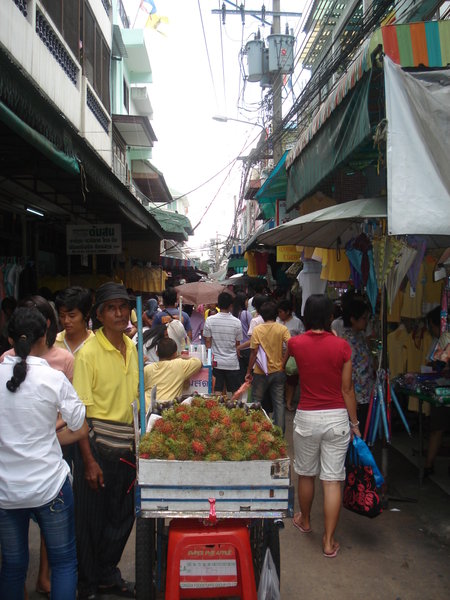
From Charoen Krung Road towards Si Ban U (Bangrak Market)
 Picture by Rodney_F
Bangrak seen from Peninsula Hotel with Mandarin Oriental Hotel (left) and Shangri-la Hotel (right) at the banks of Chao Phraya River
Where glistening high rise blocks join rows of old shophouses and crumbling Neoclassical buildings, where a roaring freeway crosses small and quiet sois, where the merchants from the West and East on their sailships and steamships used to enter into old Siam by the Chao Phraya River, where buddhist, konfucian, hindu, muslim and christ beliefers live together peacefully in a multinational community with their temples, shrines, mosques and churches, where swarms of tourists arrive at luxury riverside hotels and restaurants and where the smells of a great variety of local food come from around the corner: Bang Rak บางรัก is one of the liveliest and most picturesque neighborhoods of the City of Angels (see pictures on
ilbonito.wordpress.com). And Charoen Krung Road ist the artery of all the colcourful life and a rich heritage. Charoen Krung Road (New Road) was the first paved road of Bangkok, built in 1861 during the reign of King Rama IV at the request of foreign consuls who wanted to ride their horses and carriages for leisure and breathing fresh air, as they said. See the video
Charoen Krung Road
You have put on your shoes? Then let's start our walking tour. We start at Sathon Pier or Saphan Taksin Skytrain station and turn into
Soi Keson. We pass between Shangri-La Hotel and
Jael Aeng Beal (ศาลเจ้าเจียวเองเบี้ยว), a Chinese temple (picture by
Gerry Gantt) and arrive at Bangrak Bazaar บางรัก บาซาร์, a small street market and food center behind the Robinson Department store ห้าง โรบินสัน บางรัก (open 10.30 am till 22 pm daily). We continue to
Soi Ban U, where old wooden houses duck behind the mighty hotel complex, before we reach
Ban Oou Mosque มัสยิดบ้านอู่ (read more on
bangkoklibrary.com).
See this lively
video of the area.
We walk on to Soi Wat Suan Plu, turn right and soon see the white gate leading to the temple.
Wat Suan Phlu วัดสวนพลู: Wat Suan Phlu is a Thai-Chinese temple. All of the buildings except the Ubosot are made of wood. The Ubosot is decorated in a quite unique way with blue glass tiles. On the walls you discover a series of painted panels.
See pictures by
Duncan lp,
Boonaum Hongkham,
asiaforvisitors.com and video by
foodtravel.tv
The contrast between old and modern Bangkok you see in front of the door of Wat Suan Phlu:
Now its time to move on to Charoen Krung Road. And when we reach it we look up:
The State Tower: With 247 metres one of the tallest buildings in Southeast Asia. It counts 50 condominium units, 500 serviced apartments, 460 office units and 90 retail units. The tower has neo-classical balconies, a 40 storey high atrium inside and a 30m golden dome on top. See vagaboned's
roundview-video from up there. It was conceived in the early 1990s by the Thai architect Rangsan Torsuwan and built in 2001. Located on the 63rd floor, on The Dome, you find the open-air restaurant Sirocco. Dress appropriate, if you want to have the chance to take the elevator up there. The State Tower is home of the luxury hotel Lebua.
The Dome on State Tower
Sirocco Restaurant
Chao Phraya River seen from the State Tower
After the drink on top we go back to the grounds of Bangrak and follow Charoen Krung Road until we turn into Soi Burapha. We pass the souvenir shop Thai Home Industries (35 Charoen Krung Soi 40) and come to the gate of the Assumption Church.
Assumption Cathedral (อาสนวิหารอัสสัมชัญ): 23 Soi Oriental (Oriental Pier or BTS Saphan Taksin). This outstanding cathedral with twin towers and a centre rose window - the red brick is a contrast to the surrounding white walls - is the main Roman Catholic church of Bangkok. French missionary Father Pascal started the construction of the first church here in 1809 and completed it in 1821. The architect designed the original Assumption Cathedral with material imported from France and Italy. The church you see now dates from the 1910s. The building then was reconstructed in an Romanesque style. The costs were largely covered by a the Chinese catholic businessman,
Low Khiok Chiang, who owned the nearby Kiam Hoa Heng & Company and also donated money for Catholic parihes and missions in Singapore and Guangdong province in China, where he was born. The Rococo style interior was unusual for this part of the world. The cathedral is part of a series of buildings, other parts are the Assumption Convent, the Catholic Mission of Bangkok, Assumption Printing Press and rectory which were inhabited by the missionaries during their time in Bangkok. And next to the church you see the Assumption College, the most renowned catholic university in Thailand.
 Picture by zhaffsky
 Picture by adaptorplug
Rococo-style interieur of the Assumption Cathedral
Back from the church we walk on the Oriental Lane towards Chao Phraya River and see at our right:
East Asiatic Company: The former office of this company with its classical Venetian-style facade, built in 1884, is now a historical building. The East Asiatic Company was a Danish conglomeration that spanned the globe, active in shipping, ship-building, slaughterhouses, plantations, pharmaceutical industry, industrial companies and agencies for countless global corporations. Its founder Hans Niels Andersen also bought the premises of the current Mandarin Oriental Hotel in Bangkok and built the first luxury hotel in Siam. Read
more. The company introduced Siamese teak to Europe, as can be read
here.
 Picture by marhas
We could also have started here, arriving by Chao Phraya Express River at The Oriental Pier, or even by staying at this famous hotel:
The Oriental Hotel: 48 Charoen Krung Soi 38. It was established by two Danes named H. Jarck and C. Salje in 1876 and the earliest modern European style hotel in the Rattanakosin period. Famous writers as Joseph Conrad and Somerset Maugham used to be guests here. The original building is now called The Authors wing.
Authors Wing
After walking back we turn into Soi Charoen Krung 38 and see a white building in front of us:
O.P. Place โอ.พี. เพลซ: 30/1 Soi Charoen Krung 38. White stone in Neoclassical style as far as the eye reaches: The O.P. Plaza (Oriental Plaza) offers you a glimpse of Bangkok in the old days. "Falck & Beidek" was the first name of the store, that was located here and owned by a German company established in 1878. The Oriental Plaza followed in 1908. Today it's said to be a good place for looking for antiques, jewellery, art, tailors and Thai silk. The building counts two storeys and a three-storey tower at each wing. Three gabled porches are very elegant. You walk around in corridors panelled in shining wood, the appearence of wealth (see
pictures on skyscrapercity.com). If you come in by the central entrance you will see at the back of the lobby an old style elevator. On the third floor you find The Ashwood Gallery, which deals with a wide range of antiques from Burmese alabaster sculptures to Japanese and Chinese prints. On the second floor, there is a small coffee shop with comfortable armchairs.
After whe have shopped not too much - to avoid heavy bags - our feet bring us to Soi Charoen Krung 36, back to the history of Bangrak. First we pass the
French Embassy and the Ambassadors Residence, dating from the mid of 19th century. Then we arrive at the banks of Chao Phraya River:
Old Customs House: Soi Charoen Krung 36. The house right at the banks of Chao Phraya River, called Sunlaka Sathan, and once the gateway to Thailand, is rundown today, but some oldtime elegance remains. In 1888 - after Thailands economy had changed from monopolized to free trade - King Rama V commanded to build it. The italian architect
Joachim Grassi designed it in
Neoclassical style (read a
study about the custom house). When the ships carrying merchandise from foreign countries entered the city they had to pass through this customs area. The tax was called Rong Phasi Roi Chak Sam, that's why peole called the house Rong Phasi.
In 1949 the custom office was moved to a new port at Khlong Toey. So the house was transformed into
Bangrak fire brigade station and from then on neglected. Sometimes it was used for movies, for example in 1984 for "Killing Fields" and also for Wong Kar Wai's
"In the Mood for Love". See pictures on
imeriah.blogspot.com,
kai1981.
In 2005 real estate consortium Natural Park got a 30-year concession from the Treasury Department. The plan was to renovate the building and turn it into an Aman Resorts hotel. But in the following decade nothing happened. There was a dispute about the removing of the fire station (read
more). Then, in May 2019, real estate investment firm
U City Plc and joint venture partners
Aman Resorts Services and
Silverlink Resorts inked a development deal with the Treasury Department of Thailand's Ministry of Finance (read
here). U City plans to spend 3 billion baht (US$ 94 million)
restoring and developing the property as a luxury hotel, what should be completed by 2025. Work will begin with archaeological excavation and cataloguing together with the Fine Arts Department. The plans: renovation of the heritage building and construction of a new building. During Bangkok Design Week in Februrary 2020 Customs House served as a venue for a photo exhibition by Thanphuying Sirikitiya Jensen (read
here).
 Picture by marhas
This soi has a dead end, so we walk back to the French Embassy and notice the entrance to a soi leading to Haroon Mosque. You enter an area of small sois with traditional wooden houses.
Haroon Mosque มัสยิดฮารูณ: 25 Chareon Krung 36 Road. In 1837 Musa Bafadel, an Indonesian-Arab trader from Borneo, who was sailing between Siam, Malaya and Indonesia, arrived here and decided to reside in this place with his three sons. One of them, Haroon, continued his fathers businesses between Siam and Malaya. When Haroon passed away his son Muhammad Yusuf Bafadel took care of his legacy. He constructed the mosque. When the Royal Thai Government needed the land for the construction of Customs House, it offered Yusuf Bafadel pieces of land in the inner side in exchange of the land of Ton Samrong, where the mosque first was situated at the banks of Chao Phraya River. The wooden mosque was moved. In 1934 Muhammad Yusuf decided to replace the wooden mosque with a brick and lime. He sacrificed his properties by selling land and Indian traders also donated for the building. The new mosque was "the talk of the town in size, wooden decorative art and craftsmanship", writes
haroonmosque.blogspot.com. A muslim community has developped around the mosque and returns to prayer here every Friday. And the foodstalls then are worth a visit, the food like chicken mataba or beef biryani "is delicious, as it is all cooked by housewives, grandmothers and other senior female members of the community", notes
Bangkok Post. Be there early and before 11am, because the delicacies have gone until then!
Or you would prefere to go to a restaurant with best references? We make just some steps on So Rong Phasi and then turn right:
Tongue Thai Restaurant: 18-20 Soi Charoen Krung 38. Curries and spicy salads are awaiting you in a 100-year-old converted shophouse. The reviews on
tripadvisor.com are a bit mixed, some very good, some disappointed. See pictures by
wcher. Open 11am-10.30pm daily.
Nearby you will discover:
Wat Muang Khae วัด ม่วงแค: Soi Charoen Krung 34
Guardian at the entrance to Wat Muang Khae
From the pier of Wat Muang Kae you can take the Chao Phraya Express bot back to the Oriental Hotel or forward to the River City Pier. But may we you would like to walk on? After seeing all these old buildings from outside its time to have a look at the inside. How did the people in Bangkok live in their houses? We stroll back to Charoen Krung Road, move a bit north. We pass the General Post Office, that was built in art-deco-style and once used as the British Embassy. And then we turn into Soi Charoen Krung 43, a quiet road with many historic houses, that crosses the expressway below. Then we arrive:
Bangkokian Museum พิพิธภัณท์ชาวบางกอก: 273 Soi Charoen Krung าซอยเจริญกรุง 43. +66 2 233-7027. You already have got an idea how Jim Thompson lived in Bangkok? Now get an idea of the lifestyle of middle-class Bangkokians in the period of World War II. The museum is hiding behind the trees of a pleasant garden, a quiet oasis away from the noise of Charoen Krung Road. The wooden home of the Suravadee family has been built in 1937. A living room, a dining room and bed rooms with furniture of this time have been preserved. You discover antiques like the old Benjarong jar, made from Thai porcelain in five basic colors, household items, a kitchen, sanitation and toilet facilities.
The house has been turned into a museum by inheritor Ajarn Waraporn Surawadee, a teacher, two years after her mother died. She could have made a fortune by selling her inherited property. Instead in 2003 she kept one house and gave the other part of the compound to the Bangkok Metropolitan Administration to become a folk museum (read
The Nation). And for many years she has been guiding guests of the musem herself, when she is at home.
Her stepfather Francis Christian, an indian doctor, who graduated in England, built the house, that is now situated at the back. It was intended to serve as a clinic on the ground floor and living quarters at the upper floor and first constructed in the Thung Mohammek District. But the doctor died, before he could move in. So the house was rented and later transferred to the ground of the museum. It shows a combination of Eastern and Western lifestyle. The third building is a two-storey eight unit row of houses, which were for rent. A part of museum presents the history of Bang Rak and Silom with farms, canals and windmills, which formed the picture of this area. Read more on
[chil-suht] and on
Having "Me" Time. See photos by
ซาสี่สีส้ม,
natski13 and
thebezz.
Open: Wednesday to Sunday, 10 am till 17 pm.
 Picture by gunofthepatriots
Oh, this was a long way. But of course there are more attractions in Bangrak. For example:
Sri Mahamariamman Hindu Temple (วัดพระศรีมหาอุมาเทวี): 2 Pan Rd (BTS Chong Nonsi). +66 2 238-4007. 06:00-20:00 daily. One of only two Hindu temples in Bangkok, the Sri Mariamman Temple is actually a great experience. It was created in the 1860s by Tamil immigrants, and as with any temple found in India, it is unique, very colourful and ornately detailed. It generally is a busy temple with a constant stream of worshippers lighting incense sticks and plenty of ceremonies going on. Besides Indians, there are also Thai visitors as Buddha images stand side by side Hindu deities inside the temple. As it is the most sacred place for the Indian community in Bangkok, it is not allowed to take pictures inside the temple compound.

Picture by Axel Drainville
Cultural diversity is what makes Bangrak as interesting as it is. If you like to experience more of it, you
should eat where the locales eat.
shesimmers.com tells you, where the traditional food stalls are: from Thai desserts to goat bryani at the Muslim Restaurant, grilled Bananas to the roasted duck restaurants Prachak (ประจักษ์เป็ดย่าง) and Nai Sung (เป็ดย่างนายสูง) or Chinese rice dumplings. shesimmers.com is written by Leela Punyaratabandhu, who lives in Chicago, but visits here hometown Bangkok often. Also
Motormouse from Ipoh writes about the food stalls in Bangrak. Mor tipps you get on bk.asia-city.com by
Pieng-or Mongkolkumnuankhet
If you don't want to discover the food diversity by yourself, you can book the halfday
Historic Bangrak Food Tour.
Charoen Krung Road with Robinson Plaza behind
From Charoen Krung Road towards Soi Wat Suan Phlu
Discover more:
Enjoy the food culture in Bangrak:
Mouthwatering food in Bangkok: Look for the section about Bangrak
In the South of Bangrak Walking tour:
In the North of Bangrak Walking tour:
Discover more in Bangkok:
#MyKrungthep: Your Guide to Bangkok
 Picture cysewski
 Picture cysewski



 Picture marhas


